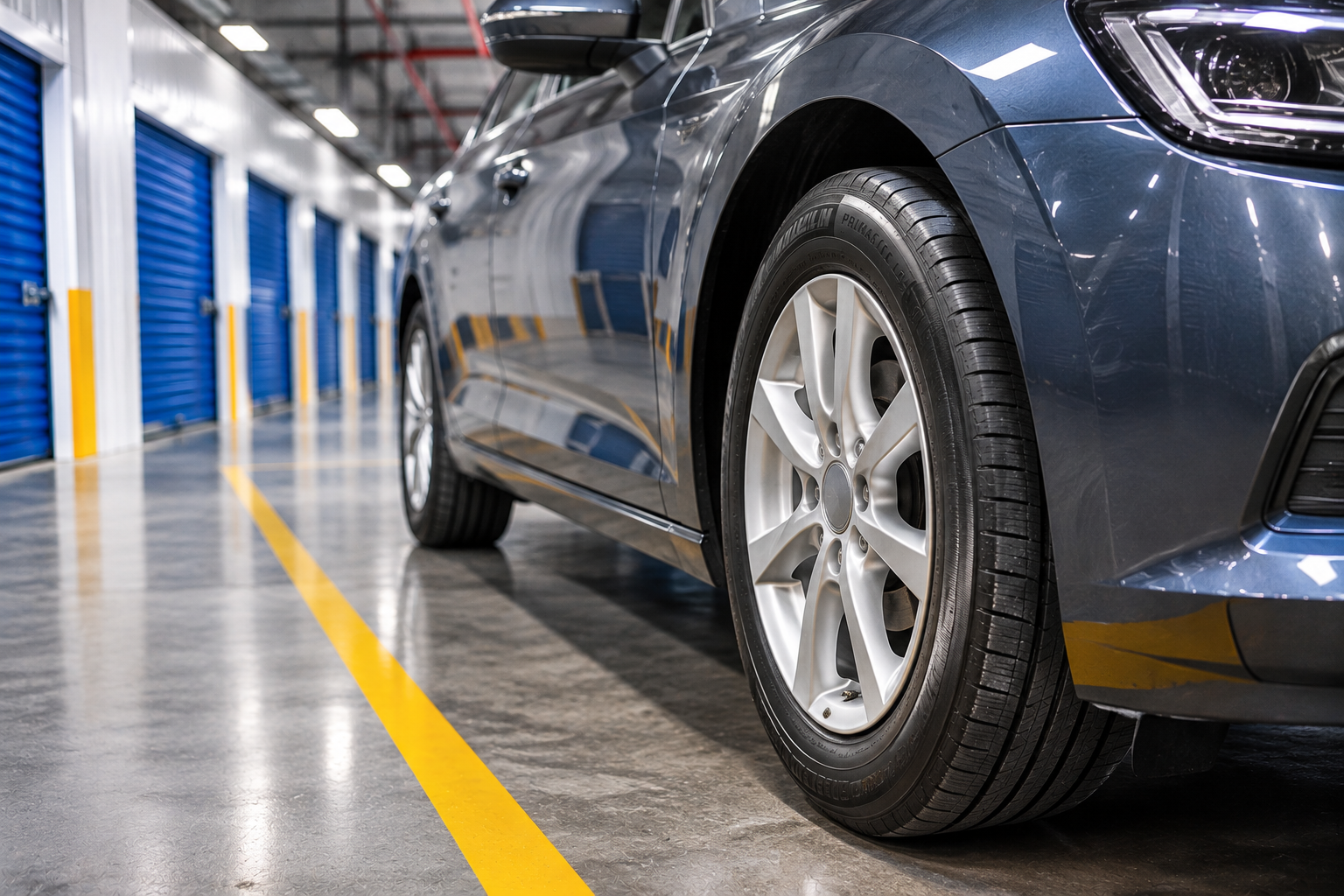
Want to prevent tyre damage during long-term car storage? Start by giving the tyres more thought than most people do. Maybe you’re heading home for the summer or relocating for a project. Or maybe you just don’t need a second vehicle right now. The engine and battery usually get the attention. The tyres often get forgotten, until you drive off and feel the steering wheel shudder.
Tyres are meant to roll. Park a car for weeks and the same small patch of rubber carries the whole car, every single day. Meanwhile, the air inside is slowly leaking out. Not fast — you won’t see it happen. But after a couple of months, it shows. That’s where most long-term vehicle storage problems come from: flat spots, soft tyres and, now and then, damage you can’t undo.
Whether that happens to your car depends on a handful of things. How old the tyres are. What shape they’re in. How heavy the car is, what pressure the tyres are sitting at, what they’re parked on, how hot it gets, and how long you’ll be gone.
None of it is hard to avoid. Three jobs, done before you go, will sort out most of it. Start by giving each tyre a good look. Set the tyres to the pressure your car’s maker recommends. And park somewhere flat, firm and clean. After that, it’s a matter of checking on them while the car’s stored and again before you drive.
Throughout, your vehicle manual and tyre manufacturer’s guidance should come first. If you’re arranging car storage in Dubai, ask your facility what it allows and offers before you hand over the keys.
What Happens to Tyres When a Car Is Stored?
Two things happen to a parked tyre, slowly and quietly.
It loses pressure. All tyres lose a little air over time, even when nothing is wrong. Over weeks or months, that adds up. In Dubai, temperature swings matter too. Pressure rises as the air inside warms and drops as it cools, so readings taken at different times of day won’t match.
It takes on a set. The section of tread touching the ground carries the car’s weight continuously. Over time, that section can flatten slightly. This is what people mean by tyre flat spots during storage. Lower pressure and higher heat can make it worse, because a softer tyre deforms more under the same load.
Not every flat spot is a disaster. Many are temporary. You’ll feel a vibration when you first drive off, and it fades within a few kilometres as the tyre warms up and regains its shape.
Some don’t fade, though. A car stored for a long time, on underinflated tyres, in heat, can develop a flat spot that stays. If vibration continues after a proper drive, don’t assume it’ll sort itself out. Have the tyres checked by a professional. It could be a lasting flat spot, a balance issue or internal damage.
Some tyres need closer attention before storage than others:
- Older tyres, which may already be hardening or cracking
- Damaged tyres, with cuts, bulges or previous repairs
- Underinflated tyres, which deform more under load
- Tyres on a heavily loaded vehicle, carrying more weight than usual
Inspect Tyres Before Storage
If you’re working out how to store a car for months, start with the tyres. A proper look takes ten minutes and tells you whether they’re fit to sit for that long.
Check the tread. Look for uneven wear across the width of the tyre, like one edge more worn than the other or patchy wear. That can point to alignment or pressure problems worth fixing.
Check the sidewalls. Look for cracks, cuts, bulges, or blisters. Sidewall damage is serious. A bulge in particular can mean internal damage to the tyre structure.
Look for embedded objects. Nails, screws, stones and glass. A slow puncture you don’t notice today can leave a tyre flat by the time you come back.
Check the tyre’s age. Every tyre has a four-digit date code on the sidewall. The first two digits are the week and the last two are the year. A tyre with plenty of tread can still be old. Rubber ages, especially under strong sun and heat. If you’re not sure your tyres are still serviceable, ask a qualified tyre shop or check the manufacturer’s advice.
Know your correct cold tyre pressure. It’s printed on the vehicle placard, usually inside the driver’s door frame. Some cars have it in the fuel flap or glovebox instead, and it’s always in the owner’s manual. Use that figure, not a number from a forum or a generic blog. “Cold” means the car hasn’t been driven for a few hours and hasn’t been sitting in direct sun.
Fix problems first. Spotted damage? Get it repaired or replaced before the car goes into storage, not after. It’s tempting to leave it for later, but a tyre that’s already weak won’t sit quietly for three months under the car’s weight. It’ll come out worse than it went in.
Set Up the Vehicle for Long-Term Parking
People asking about tyre care while the car is parked usually focus on the tyres. Fair enough. But where the car sits, and how, counts for just as much.
Choose a clean, firm, level surface. On flat ground, all four tyres share the weight about equally. Park on even a slight slope and some of them end up doing more of the work. You want something solid underneath too. A sealed concrete floor is ideal. Soft ground, gravel, or a spot covered in grit and debris isn’t.
Set pressure according to manufacturer guidance. When it comes to car tyre pressure in storage, some vehicle and tyre makers give specific advice, and many don’t. Follow what yours says. You’ll often see blogs recommending a fixed amount of extra PSI for storage. Don’t apply a generic figure blindly, and never exceed the maximum pressure printed on the tyre’s sidewall.
Avoid surfaces that can harm the tyres. Look at what’s on the ground before you park. Oil, fuel, or chemical spills can eat into rubber over time. So can sharp bits of debris you’d never notice from the driver’s seat. And in Dubai, sun is the big one. Months of it bakes the rubber, which is why covered or indoor storage is worth it — your paintwork will thank you too.
Use tyre cradles or lift the vehicle only if approved. You’ve probably seen tyre cradles. They’re curved supports the tyre sits in, so the weight spreads over a wider area and flat spots are less likely. Stands go a step further and lift the car so the tyres carry nothing at all. Both work, but only if they’re right for your car and someone sets them up properly. Get it wrong, and you can damage the suspension or leave the car unstable. So check your manual first. Then ask your storage facility whether they allow either option and who does the setup.
Should You Move the Car During Storage?
Rolling the car a short distance changes which part of the tyre carries the load. In theory, that reduces the risk of a flat spot setting in.
In practice, it isn’t always an option. Before planning any movement, check these:
- Facility rules. Many storage sites restrict access or vehicle movement.
- Insurance. Your policy may have conditions about a stored vehicle being moved or driven.
- Access. Someone has to be there, with the keys, to do it safely.
Be cautious about starting the engine or driving the car just to move it. A car that’s been sitting may have a weak battery, brakes affected by surface corrosion, or fluids that need checking. A brief start with no real drive can also do more harm than good to some systems. If you want the car exercised during storage, ask your vehicle maker or a mechanic what’s appropriate, and check whether your storage provider can arrange it.
If regular movement isn’t practical, and for many owners it isn’t, focus on what you can control. That means good pressure before storage, a suitable surface, and periodic pressure and condition checks where your facility allows them.
How to Check Tyres After Storage
Collection day. Before you drive anywhere, give the tyres the same attention you gave them going in.
- Walk around the car. Look at every tyre for obvious pressure loss, cracking, bulges, visible flat areas, or damage. Don’t forget the inner sidewalls if you can see them.
- Check and correct the pressure. Inflate each tyre to the recommended cold pressure on the placard. If you set a different pressure for storage, bring it back to the normal driving figure now.
- Drive gently at first. Keep your speed moderate for the first few kilometres and give the tyres time to warm up.
- Pay attention. Feel for vibration through the steering wheel or seat. Notice any pulling to one side or unusual noise.
Mild vibration that fades as you drive is usually a temporary flat spot working itself out. Vibration that doesn’t fade, pulling, noise, or visible damage is a different matter. Stop using the vehicle and have it checked by a qualified tyre professional before you rely on it.
Tyre Protection Checklist
Save this for before and after storage:
☐ Inspect tyre condition, tread, sidewalls and age before storage
☐ Have embedded objects removed and any damaged tyre repaired or replaced by a tyre shop
☐ Record the recommended cold pressure from the placard or manual
☐ Set pressure as directed by your vehicle or tyre manufacturer
☐ Park on a clean, firm, level surface, out of direct sun where possible
☐ Use tyre cradles or stands only if approved for your vehicle and facility
☐ Arrange periodic pressure and condition checks suited to the storage period
☐ Before driving, inspect all tyres and reset to normal cold pressure
☐ Drive gently at first; get persistent vibration or visible damage checked professionally
Conclusion
Tyres don’t need much to come through storage in good shape. Inspect them properly before you park. Set the right pressure. Choose a suitable surface. Check them again before you drive. That’s how you prevent tyre damage during long-term car storage. Most problems come from skipping one of those steps.
A lot of storage advice floating around is generic. Add this much air. Roll the car every so often. It sounds sensible, but it wasn’t written with your car in mind. Your manual was. So check that first, along with whatever your tyre manufacturer says.
Planning long-term car storage in Dubai? Talk to My Space Storage about our vehicle-storage options, what we need from you before drop-off, and what’s permitted while your car is with us. A quick conversation now saves you a shuddering steering wheel later.
READ MORE- How to Protect Your Car Battery During Long-Term Storage