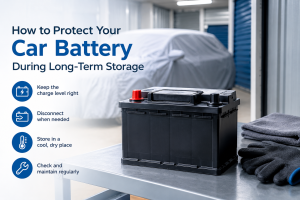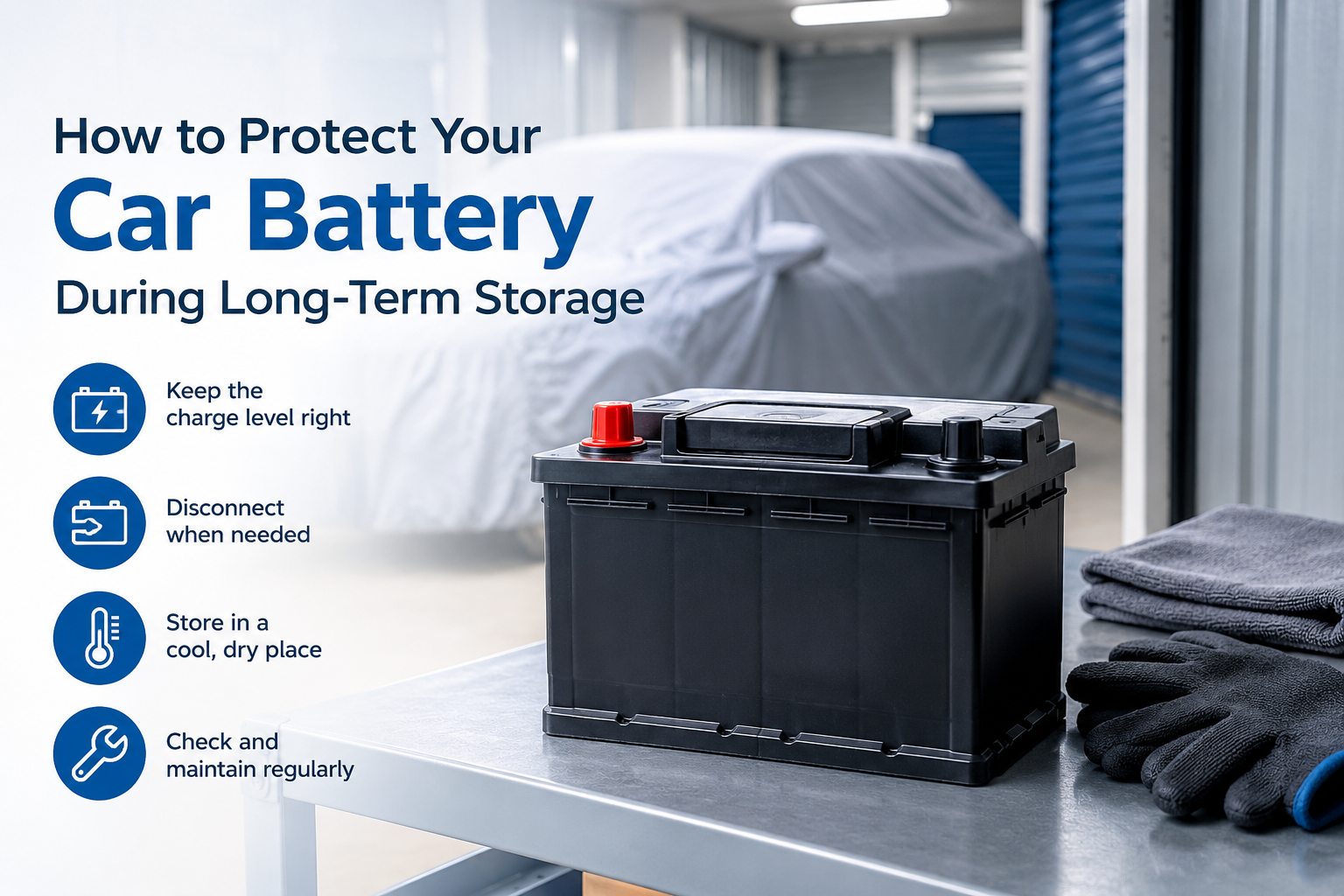
You lock the car, fly out for the summer, and forget about it. Want to protect your car battery during long-term storage? Then it’s worth five minutes of thought before you leave, not after.
Picture the return. It’s September. You’ve just landed, you’re tired, and the car makes a sad clicking noise instead of starting. Nothing’s broken, exactly. The battery has just been quietly giving away its charge for three months, and nobody was there to top it up.
Will that happen to you? Hard to say. It depends on how old your battery is, how many electronic systems your car keeps running while it sleeps, how hot the space is, and how long you’re gone. A newish battery in a simple hatchback might be fine after a long break. A tired one in a gadget-heavy SUV? Less so.
So there’s no magic fix. But there is a sensible routine. Check the battery before you go. Read your manual (yes, really). Use an approved maintainer if your car and the facility allow it, and ask a technician when in doubt. If you’re planning long-term car storage in Dubai, here’s how to work through it.
Why Can a Car Battery Drain in Storage?
A car that’s switched off isn’t really off.
Your alarm is still watching. The immobiliser is still on duty, and the keyless entry is still listening for your fob. Then there’s the clock, the connected-car app, and a handful of control modules that wake up now and then to check on things. Each sips only a tiny amount of power. On a normal day, the alternator replaces it the moment you drive. In storage, nothing does, and those sips add up over weeks. Fitted a GPS tracker or a hard-wired dashcam? That’s more drain on top.
Then there’s the battery itself. Even with nothing connected, a battery slowly loses charge through its own chemistry. Heat speeds that up. It’s one reason car batteries in the UAE tend to wear out sooner than they would in, say, the UK.
Age matters too. An old battery simply has less in the tank, so it hits “won’t start” sooner. And a lead-acid battery left sitting completely flat for too long can be permanently weakened. You charge it back up, and it never quite holds what it used to.
How fast all this happens varies enormously from car to car. Be wary of anyone who tells you exactly how many days your battery will last.
Your Battery Type Matters More Than You’d Think
Most cars run a standard flooded lead-acid battery. Cars with start-stop systems usually have an AGM or EFB battery instead, and some performance cars and EVs use lithium. They don’t all charge the same way, so a charger that suits one can be wrong for another. Not sure which yours is? The label on the battery will tell you, and so will the manual.
Hybrids and EVs Aren’t Off the Hook
People assume an electric car is immune to battery trouble in storage. It isn’t. Hybrids and EVs still carry a small 12V battery that runs the locks, screens and electronics. If that one dies, the car can refuse to wake up, even with a big main battery full of charge.
The main battery has its own rules. Some carmakers suggest storing it at a partial charge rather than 100%, and checking it during long breaks. Your manual will spell it out for your exact model. Follow it to the letter.
What to Do Before Storing the Car
Many battery problems in storage start before the car is even parked. Preparing a vehicle for storage properly is the difference between a car that starts the first time and one that leaves on the back of a truck.
Start with the battery itself. When was it fitted? Check the label or your service records. Pop the bonnet and look at the terminals. White or green crust means corrosion. Glance at the case too, for any cracks or bulging. If the battery is more than about three years old, or something just seems off, get it tested. A workshop or mobile battery service can do this quickly, and swapping a weak battery now is far less hassle than dealing with it in September.
Has the car been slow to start lately? Or has the battery gone flat after just a few days parked? Get that looked at before you go. Storage won’t fix an electrical fault. It’ll just make it obvious.
If a service is due, book it. You want to start storage with a properly charged battery and a charging system that works.
Then do a quick sweep:
- Unplug phone chargers, dashcams and anything else in the sockets.
- Make sure the interior, boot and glovebox lights are off.
- Shut every door, the boot and the bonnet properly.
Here’s one people miss. On some keyless cars, leaving the fob close to the car (in a bag on the passenger seat, say) can keep the system waking up again and again. Take it with you.
Finally, read the storage and battery pages in your owner’s manual. Decide on your plan: a maintainer, disconnection, or someone checking in. Then make sure both your carmaker and your storage provider are happy with it.
Should You Disconnect the Battery?
Look up how to disconnect car battery for storage, and most guides treat it as the obvious first step. It can help, but it isn’t right for every car.
On the plus side, pulling the negative cable stops all that background drain dead. For an older car with simple electronics, it’s often a perfectly good option, and it costs nothing.
But it isn’t a full solution. A disconnected battery still loses charge through self-discharge, and faster in the heat. Leave it long enough and you can still come back to a weak battery.
On newer cars, there’s more to think about. You might lose your radio presets, clock and seat memory. Some cars need the windows, steering sensors or start-stop system relearned afterwards. Others set off the alarm the moment power returns, or ask for a radio security code you’ve long since lost. And on some cars, the boot or bonnet releases electrically. If the battery is behind it, good luck getting in.
That’s why it’s worth checking your manual, or asking a technician, before you touch anything.
If you do go ahead, keep it safe:
- Switch the ignition off and take the key out.
- Take the negative (–) terminal off first, and put it back on last.
- Use the right-size spanner. Never let a metal tool touch both terminals, or a terminal and the car body, at the same time.
- Wear eye protection, and keep sparks and flames well away.
- Tuck the loose cable aside so it can’t flop back onto the terminal.
And if the battery is cracked, swollen or leaking? Don’t touch it at all. Call a professional.
Is a Battery Maintainer a Good Option?
Most of the time, yes. If your car and the storage space allow it, a maintainer is probably the most reliable way to prevent battery drain while parked. You’ll find them sold under a few names: smart charger, battery maintainer, or car battery tender for storage. Same idea.
You clip it on, plug it in, and walk away. It keeps checking the battery. When the charge slips, it tops it up a little. When it’s full, it backs off and just ticks over. Your car comes back with a healthy battery and every setting where you left it, radio presets included.
One warning, though. A cheap trickle charger isn’t the same thing, however similar the box looks. Those keep feeding current whether the battery wants it or not, and a few weeks of that can cook a battery. If it doesn’t say “smart” or “maintainer” and mention automatic float mode, be suspicious.
Buying one? Match it to your battery. AGM, EFB, lithium and standard flooded batteries don’t all like the same charging profile. Most cars run on 12V, but confirm yours. Have a look at what the manual says about connecting a charger (some cars want it on a terminal under the bonnet, not the battery itself), and actually read the leaflet that comes in the box.
Then the boring but important bit: power. Not every storage bay has a socket. Some facilities don’t let you leave anything plugged in while you’re gone. So ask before you buy. And whatever you do, don’t run an extension reel across a hot floor or rig something up with a household charger. It’s not worth it.
Which Battery Plan Suits Your Car?
Option | Works well when | Watch out for |
Smart battery maintainer | The car and facility allow it, and there’s safe power | Matching the battery type; facility rules; the right connection point |
Disconnecting the battery | Your manual approves it, and the car’s electronics are simple | Lost settings, relearning, ongoing self-discharge |
Scheduled checks | Someone authorised can reach the car and test the battery | Quick “start and idle” visits that drain it further |
Doing nothing | Very short stays with a healthy, newish battery | Rising risk of a flat battery the longer it sits |
How Often Should You Check the Battery?
Honestly? It depends. Three weeks away is not the same as four months, and a two-year-old battery isn’t a six-year-old one. Your manual, the battery’s health and the plan you chose all change the answer.
If a maintainer’s doing the work, a quick visit to see that the light’s green (or whatever “normal” looks like on yours) is usually enough. That’s assuming your access terms let you pop in.
If you’ve disconnected the battery, it’s worth taking a voltage reading partway through a longer stay. You’re catching it before it drops too far, not after. A fully charged 12V lead-acid battery tends to sit at around 12.6V, maybe a bit more, when it’s resting. Different battery types read differently, so go by the maker’s chart, not that number.
Done neither? Check sooner. The car’s been nibbling at the battery since the day you parked it.
Now, about the friend who offers to “start it every couple of weeks”. Kind of them. Probably not helpful, though. Starting the engine pulls a big burst of power, and five minutes of idling in a car park won’t put it back. Do that four or five times and the battery can end up worse off than if everyone had just left it alone. A proper 20- or 30-minute drive is different. If that’s not possible, skip it. (There’s more on this in our guide to what happens to your car after 30, 60 or 90 days in storage.)
Nobody is able to get to the car at all? Then make your plan before you fly, even if that plan is just booking a battery test for the day you collect it.
Old battery, a history of going flat, or a car that won’t start on your return? Get it tested properly.
Signs the Battery Needs Attention After Storage
Turn the key, or press the button, and listen.
A slow, struggling crank, the kind that sounds like the car really doesn’t want to wake up, is usually the first clue. Sometimes you just get a click. Sometimes nothing at all. Other giveaways are a bit easier to miss: lights that look dimmer than you remember, a battery symbol glowing on the dash, windows going up at half speed, or a screen that takes ages to load (or doesn’t). It’s also worth lifting the bonnet. Fresh white or greenish crust on the terminals means corrosion.
A few signs mean hands off. If the battery case is bulging, cracked or leaking, or there’s a smell like rotten eggs, don’t touch it. Step back and call a technician or roadside assistance.
And don’t assume a jump-start is the answer. It might be. But modern cars can be fussy about how it’s done, with specific jump points and a specific order for the cables, and hybrids and EVs often have their own process entirely. Never jump a damaged battery. Even if a jump gets you going, a battery that went completely flat should be tested afterwards. It may never hold quite as much again. When in doubt, call someone qualified.
Battery Protection Checklist for Long-Term Storage
Screenshot this. It’s your car battery maintenance during storage plan on one page.
Before you leave
- Check the battery’s age, terminals, case and charge, and get it tested if you have doubts
- Fix any electrical faults and book a service if one’s due
- Switch off accessories and lights, and unplug everything
- Read the manual’s storage and battery pages
- Pick your plan: approved maintainer, manual-approved disconnection, or scheduled checks
- Confirm safe power access and facility rules before plugging anything in
- Keep the keys, the manual and an emergency contact number somewhere easy to find
While you’re away
- Check in according to your plan and access terms
- Recharge a disconnected battery before it drops too low
When you collect the car
- Look over the battery and terminals before starting
- Watch for dashboard warnings
- If something’s off, get help instead of cranking it again and again
- Is the space enclosed, covered, or open to the sky? This one makes the biggest difference in Dubai’s heat.
- Can I see my car while it’s stored? If so, find out how much notice they need. A day? A week?
- Am I allowed to leave a battery maintainer plugged in? For anything over a month, it’s worth knowing.
- What does the agreement say about insurance and who’s liable if something goes wrong?
- Is there a minimum stay, or a maximum one?
- What state should the car be in when I drop it off? Some places have rules on fuel level, cleanliness, or leaks. Better to have these answers on day one than to discover them on day ninety.
A Few Questions for Your Storage Provider
Where your car sits shapes what you can do for the battery. So before you book, it’s worth asking:
Is the space enclosed, covered or open? Are there power sockets, and can you leave a maintainer plugged in? What are the access hours, and how much notice do they need? Can someone else check the car on your behalf? Are there any rules on fuel level, condition or electrical equipment at drop-off?
Getting these answers on day one beats discovering them on day ninety.
Frequently Asked Questions
How Long Can a Car Sit Before the Battery Dies?
Nobody can give you an honest number for every car. A healthy, fairly new battery in a simple car might shrug off several weeks. An old battery in a car full of tech might not. Add a Dubai summer and the clock runs faster.
Does the Heat Here Actually Make a Difference?
It does. Heat speeds up what’s happening inside the battery, so it drains quicker sitting still and wears out sooner overall. Plenty of drivers in the UAE find they’re replacing batteries earlier than they ever did back home.
Trickle Charger or Maintainer: What’s the Difference?
A basic trickle charger just keeps pushing current in. A smart maintainer watches the battery and only tops up when needed. Only the second one is meant to stay on for months.
Can I Leave a Maintainer Plugged In the Whole Time I’m Away?
If it’s a smart one, that’s exactly what it’s for. Follow the instructions in the box, use a proper socket, and make sure your storage provider’s okay with it.
If I Disconnect the Battery, Will My Settings Disappear?
Some will, probably. Radio stations, the clock and seat memory are the usual casualties. A few cars also need systems relearned afterwards, which is why the manual’s worth a look first.
I Drive an EV. Does Any of This Apply?
More than you’d expect. Your car still has a small 12V battery that can go flat, and the big battery has its own recommended storage charge. The manual will tell you what yours needs.
Conclusion
If you take one thing from this: to protect your car battery during long-term storage, start with your actual car and your actual battery. Not a generic tip off a forum. Get the battery tested, spend ten minutes with the manual, and pick a plan that works for the car and the space it’s going into.
Newer cars especially, with start-stop systems, lots of electronics, or hybrid and electric drivetrains, don’t all play by the same rules. Your manufacturer’s guidance comes first. A good technician covers the rest.
And if you’re sorting out long-term car storage in Dubai, get in touch with My Space Storage. We’ll talk you through the vehicle storage options, how access works, and what to arrange before drop-off. Then the car’s ready when you are.