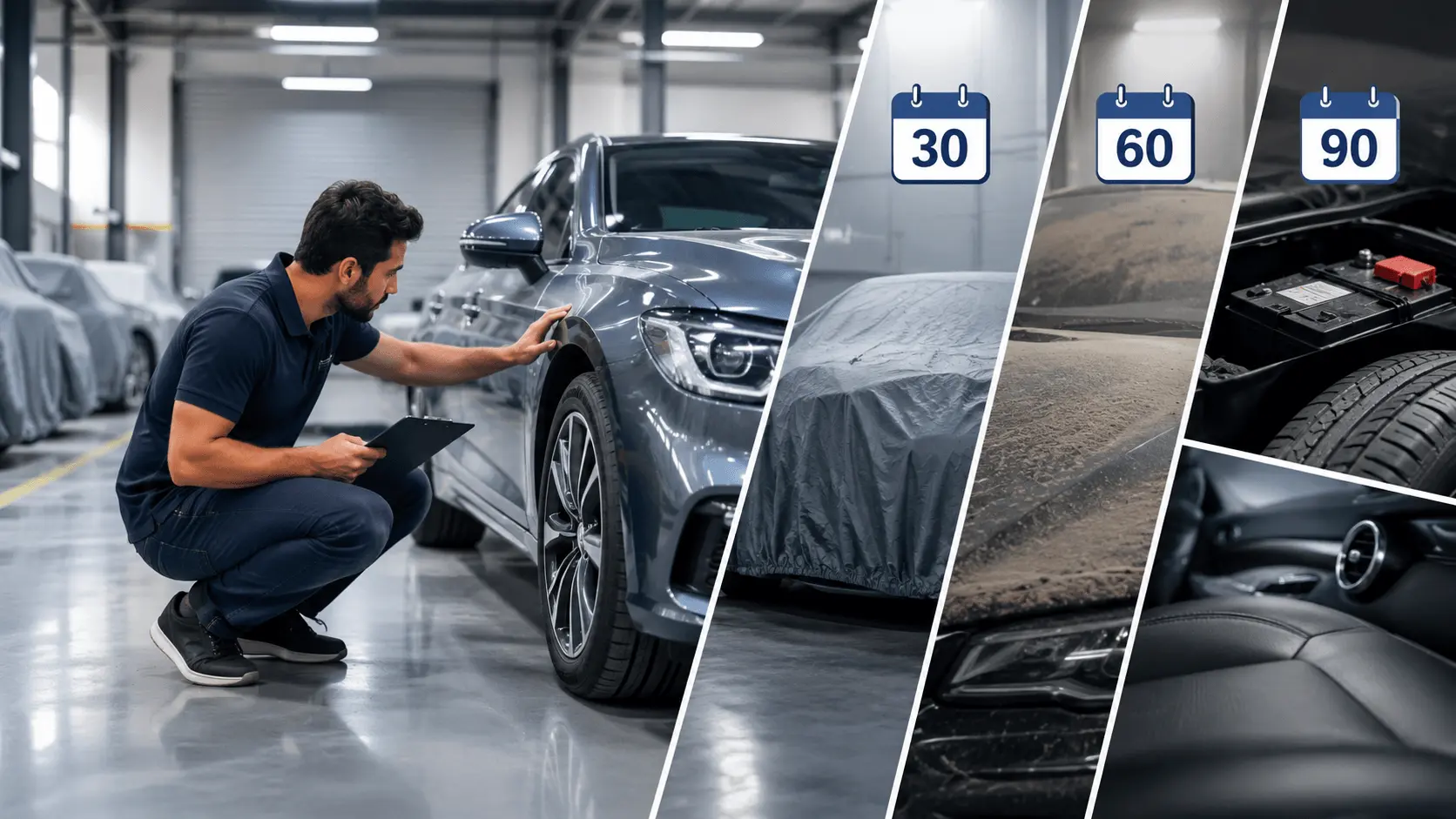
Planning car storage for 30, 60, or 90 days? Here’s the thing: a parked car isn’t a paused car. Even with the engine off and the keys in your pocket, small changes keep happening. The battery slowly drains. Tyres lose a little air. Dust settles, metal reacts to moisture, and fuel ages in the tank.
That doesn’t mean your car will come back damaged. Most vehicles handle weeks or months off the road without drama. A lot depends on the car you started with. Was it in good shape when it went in? Where has it been sitting, under a roof or out in the sun? Did you prep it before you left, or just park it and go? And has anyone checked on it since?
Either way, it’s worth knowing what tends to happen at each stage. The battery and tyres usually feel it first. After that, it’s things like fluids, brakes, dust and dirt, and the occasional uninvited pest. We’ll go through each one, then give you a checklist you can actually use.
Car storage in Dubai adds its own twist. Long summers, coastal humidity, and fine desert dust all shape what happens to a vehicle that isn’t moving. Throughout this guide, one rule applies: your owner’s manual comes first. When something looks wrong, a qualified mechanic is the right call.
At a Glance: What Changes and When
Area | Around 30 days | Around 60 days | Around 90 days |
Battery | Gradual drain; older batteries may weaken | Starting may be hard without a maintainer | Flat battery likely if nothing was done |
Tyres | Slow pressure loss | Possible temporary flat spots | Flat spots and low pressure more likely |
Brakes | Usually fine | Light surface rust possible on discs | Rust and sticking more likely; check before driving |
Fuel and fluids | Rarely a concern | Worth checking manufacturer guidance | Fuel freshness and seals worth inspecting |
Interior and pests | Low risk if clean | Musty smells possible if damp | Odours and pests possible if unprepared |
These are typical patterns, not fixed rules. A well-prepared car in a good space may show none of them.
What Can Change During the First 30 Days?
The first month is usually the gentlest stretch. But a few things are already in motion.
The battery starts losing charge. Modern cars never fully switch off. The alarm, immobiliser, keyless entry, telematics, and various electronic modules all draw a small amount of power around the clock. When you drive, the alternator tops that back up. In storage, nothing replaces it. A healthy battery can usually cope for a month, but an older one, or a car with a heavier standby draw, may already feel weaker.
Dubai’s heat matters here too. High temperatures speed up battery ageing, so batteries in the UAE often wear out sooner than in cooler climates. If yours is a few years old, it’s the part most likely to let you down.
Tyres lose a little pressure. Every tyre leaks air slowly, moving or not. Temperature swings make readings jump around as well. Low pressure matters because the tyre carries the car’s weight less evenly, which can affect its shape over a longer stay.
The exterior collects whatever’s in the air. An enclosed unit and an open car park are completely different environments. Outdoors, dust, sand, bird droppings, and sun all go to work on paint and trim. Indoors, the risks drop sharply, though dust still finds its way in.
Thirty days isn’t a magic threshold. Some cars will be fine for much longer. Others, especially those with tired batteries, may struggle sooner. Treat it as a sensible first checkpoint.
What Can Change After 60 Days?
Two months in, those small changes from the first month start piling on top of each other.
The battery is usually the first to complain. If nothing’s been keeping it charged, you might turn the key and get a slow, tired crank. Or nothing at all. Ask anyone who’s come back to Dubai after a long summer away, and this is the story you’ll hear most.
Tyres can pick up flat spots. Think about it: the car hasn’t moved in weeks, so the same small patch of each tyre has been holding up the weight the entire time. Add a bit of air loss on top of that, and the rubber can flatten slightly where it meets the ground. You’ll probably notice it as a wobble or vibration when you first pull away. Most of the time it smooths itself out after 20 minutes or so of driving, once the tyres warm up. If it’s still there after that, have them looked at.
Brake discs may pick up surface rust. Brake discs are bare metal. Normally, every stop wipes away the thin film of rust that forms on them. In storage, it stays. Humidity speeds this up, which is worth noting if the car is kept near the coast, as many Dubai storage facilities are. Light surface rust usually clears with a few gentle stops. The key word is gentle.
Fuel and fluids become a consideration. Petrol slowly degrades in the tank, and estimates of how fast vary widely depending on the fuel and conditions. For a two-month stay, it’s rarely a serious problem, but your manufacturer may have specific advice for longer periods. Engine fluids are built to handle far more heat than Dubai’s air, so they don’t “cook” in storage. The rubber hoses and seals that hold them are more sensitive over time.
This is where car maintenance while in storage pays for itself. A quick check at the 60-day mark can catch a weak battery or a soft tyre before it turns into a bigger job.
What Can Change After 90 Days?
Storing a car for three months is very common in Dubai, especially over summer. Plenty of well-prepared cars come back after 90 days needing nothing more than a charge and a tyre top-up. But if the car went in unprepared and nobody checked on it, a few issues become more likely.
Starting problems. A fully discharged battery is a realistic outcome after three months with no maintenance. A battery that’s been fully drained may also not recover its full capacity afterwards, so it’s worth having it tested rather than just jump-started and forgotten.
Fuel, seals, and fluids. Fuel that has sat for three months may be past its best. Rubber seals that haven’t flexed in a while can dry out. None of this means guaranteed damage, but it’s worth an inspection rather than an assumption.
Brakes. Rust on discs is more established by now. Some cars can also have pads stick lightly to discs, particularly if the parking brake was left on for the whole period. A careful first drive and a brake check are sensible.
Dust, pests, and odours. A car left with food wrappers, damp mats, or rubbish is an open invitation to insects and rodents. Trapped moisture can leave the cabin smelling musty. A clean, dry car in a sealed storage space is far less likely to have any of these problems.
After 90 days, inspect the car properly before driving. If anything seems off, have it checked professionally.
What Factors Affect a Car in Storage?
Here’s something that surprises a lot of people. You could store two identical cars, same model, same age, side by side for exactly three months, and still get them back in noticeably different condition. Why? It mostly comes down to a handful of things.
Start with the car itself. One that’s been serviced on time, with a fairly new battery and decent tyres, will shrug off a long rest far more easily than one that was already overdue for a check-up. Storage doesn’t fix existing problems. It tends to expose them.
Then there’s where it sits. Out in the open, the sun, dust, heat, and humidity get to work on paint, rubber, and plastic every single day. Put the same car under a roof or behind a closed door, and most of that goes away. In the UAE, that one choice probably matters more than anything else on this list.
The battery deserves its own mention. An older battery simply holds less in reserve. If you’ve added a tracker, an aftermarket alarm, or a hard-wired dashcam, that’s extra drain too, and it adds up over weeks.
Fuel and tyres play a part as well. A lot of guides recommend leaving a petrol tank about three-quarters full, as less empty space means less room for condensation. Your manual has the final word, though.
It also helps if someone looks in on the car now and then. Whether that’s possible depends on your storage terms and access, but even a quick check can catch a soft tyre or weak battery early.
Most of all, though, it comes down to the work you do before you hand over the keys. Preparing a car for storage properly is often what separates a car that starts the first time from one that needs a tow.
And finally, read the fine print on both sides: your car’s manual and your storage provider’s rules. Between them, they decide what you can do and what you should do.
Why Dubai Is Different
Long-term car storage in Dubai comes with conditions that guides written for Europe or North America don’t cover:
- Heat speeds up battery ageing and is hard on rubber, paint, and interior plastics in cars kept outdoors.
- Coastal humidity encourages surface rust on brakes and exposed metal.
- Fine dust and sand get into everything, including air intakes and door seals, if the car isn’t covered or enclosed.
- Summer timing means many cars go into storage at once, often for 60 to 90 days, and come back at the same time in September.
- Paperwork can lapse while you’re away. If your registration (Mulkiya) or insurance is due for renewal during the storage period, sort it before you leave, or plan for it on your return. Depending on your car’s age, renewal may also need a vehicle test.
Common Car Storage Mistakes to Avoid
Some of the most common advice about storing a car is the very thing that causes trouble later.
Take the classic “get a friend to start it every couple of weeks.” It sounds sensible, but starting an engine pulls a big gulp of power from the battery, and a few minutes of idling rarely puts it back. Do that a handful of times and the battery can end up weaker than if you’d left it alone. A proper 20- to 30-minute drive helps. If that’s not an option, a battery maintainer is the better bet.
Car covers are another one. A cheap plastic sheet seems like protection, but it traps moisture against the paint, which is the opposite of what you want. If you’re going to cover the car, make sure the cover breathes.
Then there’s the half-eaten snack in the door pocket or the wrapper under the seat. That’s how pest problems begin. Empty the cabin properly before you go.
Some people pump their tyres well above the recommended pressure to “make up” for air loss. Don’t. Stick to the figure in your manual or on the door sticker, unless your carmaker specifically says otherwise for storage.
Mothballs and repellent sprays don’t belong in the cabin either. In a sealed car sitting in the heat, the smell can linger for weeks, and your storage provider may not allow them anyway. Honestly, a clean interior keeps pests away better.
Paperwork is the one everybody forgets. You’re packing, booking taxis, handing over keys, and it slips your mind. So before you leave, take five minutes to look at three things: your insurance, your Mulkiya, and the storage agreement. Future you will be grateful.
When you finally get the car back, go easy on the brakes. It’s tempting to slam them once just to check they work. Don’t. Roll forward slowly, press the pedal gently a few times, and get a feel for how the car is responding before you head out on the road.
How to Check a Car After Storage
When you collect your car, resist the urge to jump in and drive off. Work through these steps first.
- Walk around the car. Look at the bodywork and the ground underneath for leaks, damage, or signs of pests like droppings or chewed material.
- Check the tyres. Compare pressures with your manual or door sticker. Tyres read most accurately when cold, so check before driving, ideally in the morning. Look for cracks, bulges, or obvious flat spots.
- Look under the bonnet. Check oil, coolant, brake fluid, and anything else your manual lists. If you photographed the levels before storage, compare them. A noticeable drop is worth investigating.
- Check the battery and dashboard. Turn the ignition on and look at the warning lights. If the car struggles to start, don’t keep cranking it. Charge or test the battery, or call roadside assistance.
- Test safety-critical systems at low speed. Try the brakes gently. Check lights, indicators, horn, and wipers.
- Take a short, easy first drive. A slight vibration or brake noise often fades within the first few minutes. If it doesn’t, have it checked.
- Book a professional inspection if needed. For anything longer than a couple of months, or if something feels wrong, an inspection is the safest route.
Car Storage Timeline Checklist
Use this vehicle storage checklist to plan around your storage period.
When | What to do |
Before storage | Is a service due soon? Book it before you go, not after. Wash the car properly, vacuum the inside, and leave it somewhere to dry out fully. Damp trapped in a closed car is what causes musty smells later. For the battery, tyres, and fuel, your owner’s manual is the best guide, so have a quick read. Take out the gym bag, the snacks in the glovebox, the loose change, and anything else you’d hate to lose or find mouldy. Grab your phone and take a few pictures: the paintwork, the mileage, the fluid levels under the bonnet. It takes two minutes and gives you a clear “before” to compare with. Check the dates on your insurance and Mulkiya too. If either expires while you’re away, it’s much easier to sort out now. Last of all, confirm the storage terms: when you can visit, and whether you can leave a battery maintainer plugged in. |
Around 30 days | If you’re able to drop by, have a quick look. Any leaks underneath? Dust building up? It’s also a good moment to check the battery and tyre pressure. |
Around 60 days | Go over the same checks again. If a tyre is losing air, the battery seems weaker, or you spot damp, deal with it now, while it’s still a small job. |
Around 90 days | Book a proper inspection before the car goes back into everyday use, and take your time with the first start. |
Treat this as a rough guide rather than a rulebook. It won’t replace your owner’s manual or a mechanic’s eye. Every car is a little different, and the people who built yours know it best.
Questions to Ask Before You Book Car Storage in Dubai
Storage options vary a lot, and what works for a weekend sports car won’t necessarily suit a family SUV parked for the summer. A short conversation before you sign anything can save you a headache later. Here’s what we’d suggest asking:
- Is the space enclosed, covered, or open to the sky? This one makes the biggest difference in Dubai’s heat.
- Can I see my car while it’s stored? If so, find out how much notice they need. A day? A week?
- Am I allowed to leave a battery maintainer plugged in? For anything over a month, it’s worth knowing.
- What does the agreement say about insurance and who’s liable if something goes wrong?
- Is there a minimum stay, or a maximum one?
- What state should the car be in when I drop it off? Some places have rules on fuel level, cleanliness, or leaks. Better to have these answers on day one than to discover them on day ninety.
Frequently Asked Questions
Is it safe to store a car for three months?
For most cars in decent shape, yes. Storing a car for three months is pretty routine, especially in Dubai over the summer. What makes the difference is the prep: get the battery, tyres, and fuel sorted, leave the car clean and dry, and give it a proper once-over before you drive it again.
Should I disconnect the battery or use a maintainer?
Both will do the job, but they work differently. A maintainer keeps the battery topped up the whole time, so you won’t come back to lost radio presets or reset settings. Disconnecting stops the drain completely, which is fine for many cars. Some newer models, though, don’t like it. You may need to relearn certain systems or follow a set procedure afterwards. Have a quick look at your manual, and check what your storage provider allows.
Should someone start my car while I’m away?
Only if they can actually drive it for 20 to 30 minutes. Short starts and idling can drain the battery more than they charge it.
Will flat spots on my tyres go away?
Temporary flat spots usually ease once the tyres warm up during a drive. If vibration continues, have the tyres inspected.
How full should the fuel tank be?
Many sources suggest around three-quarters full for a petrol car, to reduce space for condensation. Your manufacturer’s guidance takes priority.
Do I need to keep my insurance active while the car is in storage?
Speak to your insurer and check your storage agreement. Your registration renewal will also need valid insurance, so a lapse can create problems later.
Conclusion
Time in storage doesn’t affect every car the same way. A well-prepared car in a suitable space can sit for months and need very little attention afterwards. A car put away in a hurry may need more work when it comes out. Condition, environment, and preparation decide the outcome far more than the number of days.
Most of it is within your control. A bit of planning before you leave and a careful check when you come back make long-term car storage straightforward, whether it’s 30 days or a full summer.
If you’re looking for car storage in Dubai, talk to My Space Storage. Our team will walk you through the vehicle storage options available, the terms that apply, and what to arrange before drop-off. Get in touch to find the right setup for your car.